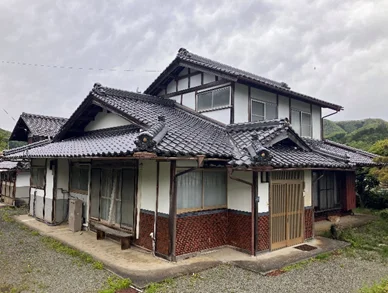
Still Forest Farmhouse
1960s wood house in Aseri, Kyotamba
Kyotamba, Kyoto
Saved homes live in this browser. View your saved homes
Location
This marks an approximate area, not the exact building. The circle is a rough radius from the listing's published address, so you can see the neighbourhood without us guessing at a precise spot.
Full description
Conditions/Remarks: Agricultural land and mountain forest present (consultation required)
Specifications
Where a detail is not shown, the source listing did not state it. We leave it out rather than guess.
Utilities
Area and hazard data
- About 23 min walk to Aseri station
- About 28.1 km from the coast
- About 2.6 km to the nearest primary school
A pre-1981 build predates Japan's current earthquake code, which can matter for insurance and renovation. We flag the era from the year built where we have it.
Land-market context
The nearest official land-price benchmark is about 7,690 yen per sqm, with local prices falling (-1.6% over five years).
Source: Japan's Ministry of Land land-price survey. A benchmark for the area, not a valuation of this home.
Matched subsidies
-
Kyoto Prefecture Wooden House Seismic Retrofit SubsidyUp to 2,100,000 yenSource
-
Migration Promotion Housing Renovation Program (for migrants and community organizations)Up to 1,800,000 yenSource
-
Kyoto Prefecture Migration Support Payment (General Employment at Destination)Up to 1,000,000 yenSource
-
Kyoto Prefecture Migration Support Payment (Professional Employment)Up to 1,000,000 yenSource
-
Kyoto Prefecture Migration Support Payment (Startup at Destination)Up to 1,000,000 yenSource
-
Kyoto Prefecture Migration Support Payment (Telework)Up to 1,000,000 yenSource
-
Regional Revitalization Migration Support Program (Household)Up to 1,000,000 yenSource
-
Regional Revitalization Migration Support Program (Single)Up to 600,000 yenSource
-
Akiya Liquidity Promotion Program (for akiya owners)Up to 100,000 yenSource
-
Kyoto Prefecture Akiya Circulation Promotion – Clearance/Debris Removal GrantUp to 50% of clearance/removal cost; cap set separately by governor. Amounts vary by municipality.Source
-
Kyoto Prefecture Migration-Promotion Housing Development – Akiya Renovation GrantUp to 50% of renovation cost. Cap determined separately by the governor. Amounts vary by municipality; must consult specific municipality.Source
Amounts change every year. Always confirm with the town before you rely on a figure.
Municipal conditions and restrictions
Some towns attach conditions to an empty-home purchase, for example a residency requirement or farmland-law (nochi-ho) approval, which is a local sign-off needed before farmland can change hands or use. These come from the source listing.
- Farmland and woodland (requires consultation)
Always confirm the current conditions with the town before you commit.
Work with us
Every message gets a reply from one of the founders. We can talk through the home, help you think about a renovation, and connect you with our Japan partner for buying help. Clear flat-fee pricing, nothing to pay until you decide to go ahead.
Where this data comes from
- Landslide-risk areas, from Japan's Ministry of Land mapping data (KSJ A33).
- Flood-risk areas, from Japan's Ministry of Land mapping data (KSJ A31a).
- Tsunami-risk areas, from Japan's Ministry of Land mapping data (KSJ A40).
- Earthquake-hazard forecast, from the national J-SHIS model (2024).
- Farmland rules, from Japan's Ministry of Land mapping data (KSJ A12).
- Stations, coastline and schools, from Japan's Ministry of Land mapping data.
- Official land prices, from Japan's Ministry of Land land-price survey.
Source listing last changed: 2026-05-11
We re-check listings against their sources through the week.
Original listing: https://www.kyoto-iju.jp/akiya_bank/akiya_bank_56758
Where a fact is missing, we say so rather than guess. Data from the source listing plus official government records.